Submitted by By Caroline Kelley on July 31, 2013. On Time
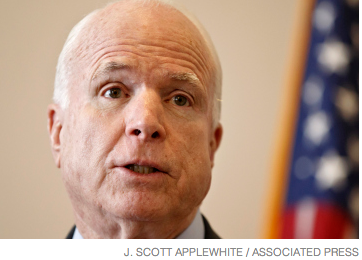
“It’s nice to be back here amongst old friends and enemies,” Senator John McCain said Tuesday morning as he opened a discussion on immigration at the Washington headquarters of the union powerhouse American Federation of Labor and Congress of Industrial Organizations (AFL-CIO). His comment earned a trickle of awkward laughter from the audience, which included congressional staff members, some undocumented Hispanic youth known as “Dreamers” and a slew of reporters eager to watch the Republican make a begrudging alliance with organized labor.
Widespread confusion over how the House of Representatives will handle pending immigration reform legislation has launched an all-lobbyists-on-deck scramble for influence on the Hill. Delegates from Silicon Valley to the cantaloupe fields of Texas are descending on Washington to weigh in, and McCain is putting aside his history with the AFL-CIO to join the fray. He discussed the importance of creating a path to citizenship for undocumented immigrants with labor-friendly congressman Xavier Becerra on Tuesday.
“Treat your opponents, those who disagree with you, treat them with respect,” said McCain, who was criticized by the AFL-CIO as an opponent of worker’s rights during the 2008 election and 2007’s immigration reform debate. The federation of unions spends big bucks promoting Democratic candidates. After endorsing Barack Obama for President in June 2008, they used roughly $53 million of their $200 million campaign budget to run “grass roots mobilization” plugging McCain’s competitor. The group even launched a website, www.mccainrevealed.org (now deleted), which attacked the Senator’s voting record and his ties to George W. Bush.
The AFL-CIO also worked against McCain’s efforts to pass comprehensive immigration reform in 2007. Although Democrats controlled the House when their bill hit the floor, McCain and Senate ally Ted Kennedy were unable to satisfy the labor lobby’s demands, which were supported by then-Senator Obama. The primary concern for labor groups was guest worker programs: initiatives that allow foreigners to reside and work in the United States during labor shortages. Such programs would have won the support of big business and the GOP, but the AFL-CIO worried that immigrants brought into the country under such initiatives would be paid less than the median wage in their respective industries. Ultimately, intra-party disagreement caused the 2007 bill to fail.
But 2013 is different, say labor groups and their congressional allies. In March, AFL-CIO President Richard Trumka struck a deal with Democratic Senator Chuck Schumer and Thomas J. Donohue, head of the business lobby Chamber of Commerce. The alliance helped secure support for bipartisan legislation later passed by the Senate. Via conference call, Schumer announced a compromise on divisive guest worker programs. He assured organizers that under the new bill, guest workers would be paid the highest prevailing industry wage as determined by the Labor Department. “This issue has always been the deal breaker on immigration, but not this time.”
Former McCain adviser Douglas Holtz-Eakin, who touted the economic benefits of immigration during a panel at the AFL-CIO on Tuesday, started his discussion by reflecting on fickle Washington allegiances. “I don’t think I’ve ever been more flattered than by the kind of words of Congressman Becerra and my former boss John McCain about my work. But I will tell you that when I was head of the CBO neither of them had a word to say about it. So, time heals all wounds and let us hope that we can get over the wounds of the past efforts on this topic and we can get something done this year.”
Whether or not Tuesday’s discussion helped push immigration reform toward passage in the Republican House—it likely didn’t—the gathering demonstrated that the issue has created powerful, if unconventional, coalitions in Washington. After his Democratic counterpart shared a moving story about his former job as a construction worker, McCain joked, “Congressmen Becerra went from an honest line of work into politics.”







 Uprooted